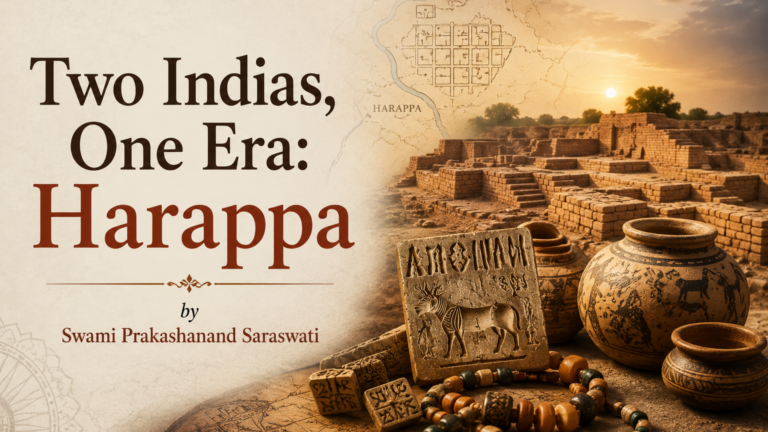
The Harappan civilization is one of the most studied ancient cultures in South Asian archaeology, and one of the most puzzling. Its seals, its planned cities, its still undeciphered script have generated decades of scholarship. But Swami Prakashanand Saraswati, in his book The True History and the Religion of India, offers a different way to read this period, one that starts not from excavation sites but from scripture.
After the Mahabharat War
Swami Prakashanand Saraswati talks of how the Mahabharat War in 3139 BC was an event that shattered the economy of the time and dissolved many of the localized civilizations across the subcontinent. Thousands of kings and millions of people died in that war, and large stretches of land across the subcontinent became uninhabited in its aftermath. Without common roads linking distant regions, communication between them was limited. Communities in different parts of India developed their own local cultures and their own spoken languages, each rooted in a classical or locally spoken form of Sanskrit and carrying forward the image of the original Bhartiya civilization.
Over time, Brahmi script and Pali language developed in India, and Pali became the language used to record the tenets of Buddhism. Swami Prakashanand Saraswati explains how the prime center of Vedic civilization was in the Mathura, Allahabad, and Varanasi region, which remained the heart of Bhartiya culture and scriptural education throughout this period.
The Harappan Culture, Read Differently
Meanwhile, communities around the Indus Valley developed their own civilization, later named the Harappan culture, dated by archaeologists to roughly 2700 to 2500 BC. Swami Prakashanand Saraswati shares that this civilization stood apart from the mainstream of Bhartiya culture, which is why its linguistic and literary development remained comparatively primitive. He points out that Harappan inscriptions on seals and tablets resemble Phoenician and Semitic signs that developed later, between 1500 and 1000 BC, and became the basis for writing systems across the western world.
Against this, he provides another historical record: the Bhagwatam itself documents three public gatherings, in 3072 BC, 2872 BC, and 2842 BC, where saints and devotees came together for recitations of the Bhagwatam and discourses on Krishna’s leelas. This places a scripturally literate, Sanskrit-speaking civilization squarely within the same period as the Harappan culture.
Two Brothers, Two Indias
Swami Prakashanand Saraswati illustrates this apparent contradiction with a simple story. Two brothers, neither of whom has been to India, fly in on separate helicopters. One lands near a major research center in Bombay, meets scientists, and returns home describing an advanced, sophisticated country. The other loses his way and lands in a jungle clearing, where local tribal residents gather around the helicopter as though it were something from another world. Unable to communicate and confused by what he saw, he returns home disappointed. Each brother insists on his own account, and each struggles to believe the other, yet both experiences are entirely real and happened at the same time in the same country.
This is his framework for the Harappan question: during the same era, the Ganges valley held an advanced civilization with scholars fluent in Sanskrit, while the Indus valley region developed along a separate and less literate path. India, in his account, is never without sages and saints who carry the full knowledge of its scriptures in their minds, even in periods when other parts of the subcontinent are developing very differently.
A Different Kind of Evidence
Swami Prakashanand Saraswati raises a direct challenge to conventional historians here. He argues that even well-intentioned historians make a mistake when they try to merge Harappan culture with Vedic culture and use that merger to date the development of Sanskrit – a language he explains is eternally complete rather than something that evolved. He reasons that the history of Bharatvarsh cannot be reconstructed from limited archaeological finds such as coins, toys, and pots. He points instead to the Puranas and the wider body of Bhartiya scripture as the true record of the subcontinent’s general history. These texts are described as being the direct product of the minds of eternal saints.
Conclusion
Swami Prakashanand Saraswati’s description of this period helps readers to simultaneously hold two pictures of ancient India – an archaeological one built from Harappan seals and city plans, and a scriptural one built from the Bhagwatam’s own record of Sanskrit learning and Puranic transmission. His helicopter story makes the point directly: two very different, equally real experiences can exist in the same country at the same time. He raises a genuine question worth contemplating: a civilization’s history cannot be told fully through physical remains alone. Its documented memory deserves a place in that account too.
